
Part 1: Night follows night, and the two and three-stringed instruments talk to each other
- Skeena Reece
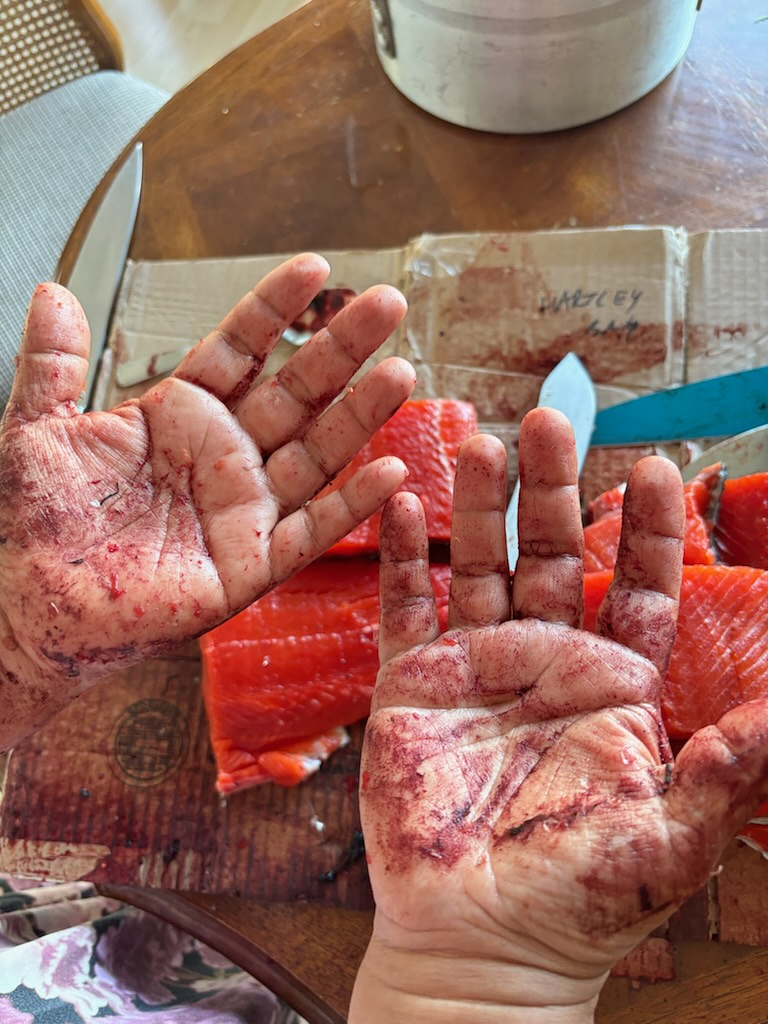
Conceived as a space of gathering, testimony and witness, Curry Cockle Chow Mein (2026) draws from the legacies and practices of the potlatch, and Reece’s Tsimshian, Gitxsan, Cree, and Métis heritage. Reece’s performance takes its title from a recipe testifying to the varied influences in Indigenous cuisine, as well as the reality that some of the first restaurants to serve Indigenous people were Asian. Curry Cockle Chow Mein challenges ideas of authenticity, breathes life into culinary objects, and nods to the historical exchange of goods and people across colonial trade routes. Reece’s performance activates the shared table as a place to rest, honour elders, and create experiences that cannot be put into words.
Curry Cockle Chow Mein is the opening event of Night follows night, and the two and three-stringed instruments talk to each other, a multimodal, multisensory assembly that moves across disciplinary and institutional boundaries. Taking inspiration from polyphonic collectives and embodied ritual practices, it brings together the resonant works of Jasleen Kaur, Christian Nyampeta & Kivu Ruhorahoza, Naufus Ramírez-Figueroa, Skeena Reece, and Constantina Zavitsanos.
Drawing its title from the poem “Ghazal 463” penned by Hafez Shirazi, Night follows night shifts attention away from representational discourse towards practices of embodiment, to accommodate emergent aesthetic forms in which song is lament, food is evidence, poetry is history, and objects speak. This assembly creates space for practices of transtemporal interlocution, interruption, eruption, and prophecy. It asks: how can we move beyond exhibitionary formats towards spaces of polyvocal collaboration, plural assembly, and fugitive sociality?
Co-curated by Susan Gibb, Vanessa Kwan, and Sadia Shirazi.
About the Artist
Skeena Reece is a Tsimshian, Gitxsan, Cree, and Métis artist based on Vancouver Island, Canada. Her multidisciplinary practice involves performance art, writing, singing, video, and visual art. She incorporates a mix of traditional knowledge, humour, socio-political observations, and spirituality to confront settler-colonial preconceptions about the experiences of Indigenous people, and specifically Indigenous women. Reece’s installation and performance work has garnered national and international attention, most notably for Raven: On the Colonial Fleet (2010) presented at the 2010 Sydney Biennale. Her recent solo exhibitions include Surrounded at the Morris and Helen Belkin Art Gallery, Vancouver (2019), and Touch Me at the Comox Valley Art Gallery, Courtenay (2018). Her video work Touch Me (2013) was exhibited at and acquired by the National Gallery of Canada, Ottawa (2025). She is the recipient of the British Columbia Award for Excellence in the Arts (2012), the VIVA Award (2014), and the Hnatyshyn Award (2017).

Accessibility
The Grand Luxe Hall is located on the second floor of Western Front, which is accessed by a flight of twenty-six stairs. While plans for a full building upgrade to facilitate access for wheelchair users are still underway, events in the Grand Luxe Hall are made available virtually via high-quality livestream (see link above).
Alternative formats: Live ASL interpretation will be available.
Further details about accessibility at Western Front can be found here.
Acknowledgements
100 Years in the Making | This event is organized in support of ECU 100, Emily Carr University of Art + Design’s centennial anniversary. Presented with support from the Audain Foundation.
Organized by Libby Leshgold Gallery, Western Front, and the Department of Art History, Visual Art & Theory at the University of British Columbia, with additional support from the Audain Endowment for Curatorial Studies; the Morris and Helen Belkin Gallery; the Indigenous Strategic Initiatives Fund; Critical Image Forum; and the Curatorial Research Cluster at the University of British Columbia.







Western Front is a non-profit artist-run centre in Vancouver.
We acknowledge the xʷməθkʷəy̓əm (Musqueam), Skwxwú7mesh (Squamish), and səl̓ílwətaʔɬ (Tsleil-Waututh) Nations as traditional owners of the land upon which Western Front stands.