Thought, outside
Description:
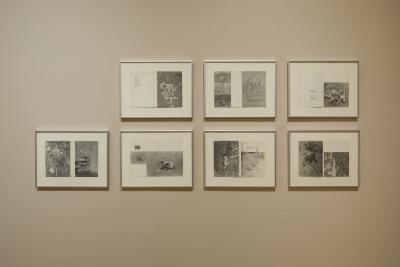
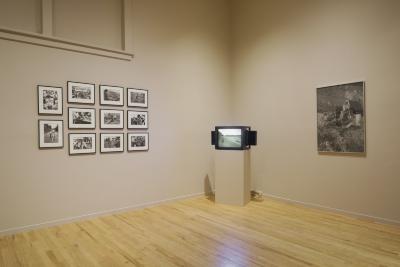
Thought, outside was an exhibition of lens-based artworks produced between the 1970s and ’90s by Craig Berggold, Marlene Creates, Kiss & Tell, Roy Kiyooka, Laiwan, Ken Lum, and Melinda Mollineaux. The works engage then-emerging frameworks of multiplicity, plurality, and decentering that make the contingent nature of the outside visible. “Outside” is variably expressed as the condition of being out-of-doors, beyond a geographic delineation, without legal recognition or unfamiliar with social custom. It is a position that is sometimes articulated in the negative: by that which is not inside. However, the boundary between the inside and outside is rarely fixed or exclusive; rather, it is relational, durational, and transitory.
Thought, outside was curated by Amy Kazymerchyk, a candidate for the MA in critical and curatorial studies at the University of British Columbia. The exhibition was presented with support from the Killy Foundation and the Audain Endowment for Curatorial Studies through the Department of Art History, Visual Art & Theory in collaboration with the Morris and Helen Belkin Art Gallery at the University of British Columbia. Her research was supported by the Social Sciences and Humanities Research Council of Canada.
Documents:






Related People
Related Events
Captions:
- Thought, outside, installation view, Nov 12, 2020 – Jan 30, 2021. Photo by Dennis Ha.
- Thought, outside, installation view, Nov 12, 2020 – Jan 30, 2021. Photo by Dennis Ha.
- Unknown photographer (198-), installation view, Nov 12, 2020 – Jan 30, 2021. Photo by Dennis Ha.
- Thought, outside, installation view, Nov 12, 2020 – Jan 30, 2021. Photo by Dennis Ha.
- Kiss & Tell, Drawing the Line (1990), installation view, Nov 12, 2020 – Jan 30, 2021. Photo by Dennis Ha.
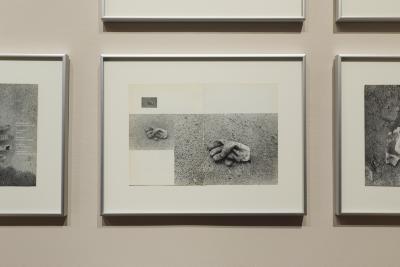
- Roy Kiyooka, StoneDGloves (1970), installation view, Nov 12, 2020 – Jan 30, 2021. Photo by Dennis Ha.
- Roy Kiyooka, excerpts from StoneDGloves (1970) print publication, installation view, Nov 12, 2020 – Jan 30, 2021. Photo by Dennis Ha.
- Thought, outside, installation view, Nov 12, 2020 – Jan 30, 2021. Photo by Dennis Ha.
- Laiwan, African Notes Parts 1 & 2 (1982), installation view, Nov 12, 2020 – Jan 30, 2021. Photo by Dennis Ha.
- Melinda Mollineaux, Cadboro Bay: Index to an Incomplete History (1998/2020), installation view, Nov 12, 2020 – Jan 30, 2021. Photo by Dennis Ha.
- Melinda Mollineaux, Cadboro Bay: Index to an Incomplete History (1998/2020), installation view, Nov 12, 2020 – Jan 30, 2021. Photo by Dennis Ha.
- Thought, outside, installation view, Nov 12, 2020 – Jan 30, 2021. Photo by Dennis Ha.
- Craig Berggold, A Time to Change (1984), installation view, Nov 12, 2020 – Jan 30, 2021. Photo by Dennis Ha.
- Craig Berggold, A Time to Change (1984), detail, Nov 12, 2020 – Jan 30, 2021. Photo by Dennis Ha.
- Ken Lum, Entertainment for Surrey (1978), installation view, Nov 12, 2020 – Jan 30, 2021. Photo by Dennis Ha.
Back to:
Western Front is a non-profit artist-run centre in Vancouver.
We acknowledge the xʷməθkʷəy̓əm (Musqueam), Skwxwú7mesh (Squamish), and səl̓ílwətaʔɬ (Tsleil-Waututh) Nations as traditional owners of the land upon which Western Front stands.